
Pest Control & Pesticides
Bible Reference Matthew 15:18-20, Malachi 3:11
‘But the things that come out of a person’s mouth, come from the heart and these defile them. For out of the heart come evil thoughts – murder, adultery, sex immorality, theft, false testimony, slander. These are what defile a person but eating with unwashed hands does not defile them’.
Matthew 15:18-20
Jesus taught us that wickedness and sin comes from the heart.
‘I will prevent pests from devouring your crops and the vines in your fields will not drop their fruit before it is ripe’ says the Lord Almighty Malachi 3:11
I. Integrated pest management
IPM consists of 4 main steps:
1. Identification: The section on Key Signs is designed to help identify the pest or disease.
2. Prevention: This includes cultural approaches, such as use of disease resistant varieties, disease-free seed and adoption of good practices in the field, such as removal of infected material that could carry the problem over to the next crop. It also includes use of pesticides where this method is appropriate.
3. Monitoring: The earlier a pest or disease is noticed, the earlier appropriate action can be taken to reduce losses and prevent its spread.
4. Control: This includes both cultural approaches, such as removal of infected plants, as well as use of appropriate pesticides.
IPM often involves the combination of several different options. Pesticides tend to be used when other approaches are inadequate for the problem at hand; they must always be used in accordance with the usage and safety information given on the pack.
With most pests and diseases, the earlier the problem is noticed the better. The best way of achieving this is to regularly and systematically inspect the crop by walking through the field or plot following an M-shaped pattern; this will ensure the farmer doesn’t just look around the edges but also looks in the middle.
Signs on the crop might include:
• Has the plant wilted – that is has the plant become less rigid than normal and is drooping?
• Are the leaves more yellow than usual?
• Have the leaves changed from green to some colour other than yellow?
• Are the plants smaller than usual?
• Have parts of the plant died?
• Are there unusual streak patterns on the leaves or stems?
• Do the leaves have spots on them?
• Are the leaves chewed – are there holes in them that look as though they have been eaten?
• Are there signs of the animals that might have done this?
• Are the leaves blistered or wrinkled?
• Are the leaves or fruits an unusual shape?
• Are the leaves smaller than usual and/or bunched closer together than usual?
• Do the leaves have patterns of lighter green and yellow giving a mottled or patchwork effect?
• Are there brown marks on the edges of the leaves?
• Is there an unusual growth on the surface of the leaves or other parts of the crop?
• Are there holes in the stem or grain?
• Are there lumps or swellings on the leaves or other parts of the plant?
• Are parts of the plant rotting – that is, becoming soft and slimy?
If any of these signs are found seek advice form a knowledgeable local farmer or staff at the local agro-dealer or research station.
II. Pesticide use and safety
What are pesticides?
Pesticides are mostly chemicals although some are biological agents, such as special types of fungi, that deter, weaken, kill, or otherwise discourage pests. Pests can be insects, rodents, birds and other animals, weeds, fungi, or microorganisms such as bacteria and viruses that have a detrimental impact on crops. Some kill the plants, others weaken them or reduce the yield in some way, while others attack the crop after harvest while it is being stored prior to use. Some pests cause direct damage to the crops and others carry harmful micro-organisams, bacteria and disease.
Safety and Effectiveness
Some pesticides are often misused and can cause human health effects and environmental contamination. Some are mislabelled or are counterfeit so they should be bought from a reputable supplier. However constant use can lead to a build-up of resistance, making them less resistant. In addition it is important to only buy enough for the season and not to store it as it is dangerous a dangerous substance and could be hazardous to curious children.
Farmers must use appropriate safety precautions when mixing and using pesticides. This includes reading and following the label recommendations for use, using the right personal protective equipment (PPE) and practising personal hygiene. Information that can be found on the product label includes:
• PPE required
• What crops and pests the product can be used for
• Dosage rate
• Timing of application
• The time required before anyone can re-enter the field after spraying (REI)
• The number of days a product must be sprayed prior to harvest (PHI)
It is important that farmers read and understand what is on the label prior to use. If they are unable to read it or do not understand it, then they should find someone to help them, such as a local extension agent or family member.
III. Natural Pesticides
Organic pesticides are safer for the environment and health. The pesticides are effective in pest control and they are not dangerous to livestock on the farm such as goats, chicken and others. This organic pesticide is easy to make and does not require high capital investment to make it.
How to make a plant based pesticide (CHILLI–GARLIC PESTICIDE)
A community can work together to collate the ingredients. The pesticide is called Chilli-Garlic pesticide because chilli and garlic are the main ingredients and act as repellants in the organic pestcide. This means the pesticide does not kill offending organisms but instead repells them from attacking the crop from a distance. Another key ingredient is tephrosia localy known as “Muluku” which kills pests that ingest the leafy parts of the crop that are sprayed with it.
Ingredients
1 cup of chilli
1 bar of hard white soap
1 head of garlic
1 kilogram of Tephrosia leaves (Muluku)
20 litres of water
1 jerrican of 20 litres
Cloth
Spray pump or knapsack
Instructions
Chop the Tephrosia leaves into small pieces
Crush the chilli and the garlic
Scrape the soap into small shavings
Boil 20 litres of water with the soap until it forms a “jelly” substance
Add all of the other ingredients to the water (chilli, garlic, Tephrosia)
Stir to mix all the ingredients well with the water
Boil for 1 hour
Let the solution (pesticide) set for 1 week
After 1 week, filter the solution through a cloth
To use the pesticide, mix at a ratio of 1:2 (1 cup of pesticide with 2 cups of water)
Spray using a small spray pump or knapsack
NB: This organic pesticide can be used to control all pests and should be used within 3 weeks.
Another recipe:
1 kg of Young Mango leaves
1 mug of Black Jack leaves
1 mug of Red Pepper
1 matchbox size of Soap
Combine in 10 litres of water and store in an airtight container.
Tobacco Spray
Tobacco spray is effective against most pests, particularly aphids, and even cabbage worms to some degree.
Tobacco leaves coarsely chopped, then “scrubbed” in water to extract the plant juice.
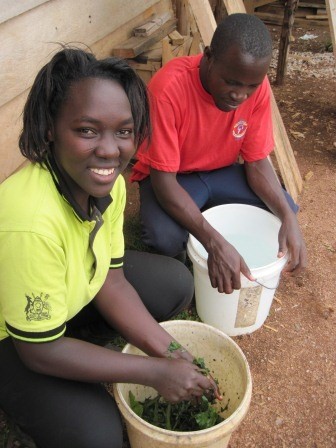
Soap is finely shaved and dissolved in water.
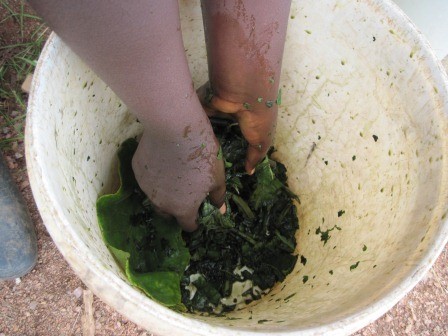
Mix all of the above together, then strain it into a backpack sprayer, and off you go!
Tobacco plants around the perimeter of gardens can deter snakes from entering.
A similar pesticide spray can be made from potato plants. Potatoes and tomatoes are in the nightshade family, and are most effective against insects that will ingest the foliage.
There are a multitude of other sprays using hot pepper, onions, garlic, basil, etc. Some websites below are interesting, though their credibility has not been confirmed:
Organic aphid sprays – http://organicgardening.about.com/od/pestcontrol/a/spraysforaphids.htm
Organic insect treatments – http://www.ghorganics.com/page14.html#Tomato%20or%20Potato%20Leaf%20Spray
Homemade organic pesticides – http://www.fraserinfo.org/cprmr/gardencare/HomemadePesticides.htm
Natural homemade pesticides – http://tipnut.com/natural-pesticides/
As with any pesticide spray, be mindful of when you spray and harvest. Make sure there are several days in between to allow the poison to break down before harvesting. Tobacco’s natural poisons work excellently against unwanted visitors. Of course, it would also work against beneficial insects. Ideally, a well-balanced ecosystem with healthy plants is your greatest asset. Any sprays are only dealing with symptoms of a larger problem. There is an extensive field of study and practice that deals with such topics, called Integrated Pest Management (IPM).
Urine and Ash
Urine and ash can be used to control crop pests and diseases in Uganda. Urine is diluted to reduce the concentration of nitrogenous compounds in the urine to avoid burning the young plants. It is diluted by mixing one part urine to one part water.
Urine can be stored for varying durations ranging from one day to three weeks before or after adding other ingredients. It is important to store it correctly to reduce the risk of spreading diseases caused by microorganisms that may be in the urine. Diluting the urine before storage lowers its concentration and therefore increases the chances of survival of microorganisms. Whether stored before or after adding other ingredients, urine must be stored in closed containers to avoid loss of ammonia and entry of pathogens. Diluted urine if kept open would also act as a breeding place for mosquitoes. Urine should also be kept out of reach of children and domestic animals to reduce chances of disease spread. Urine especially if collected from humans can be a source of diseases such as Schistosomiasis and typhoid. Storing the urine for at least one week reduces the risk of disease spread. To reduce this risk further, the following safety precautions should be taken when handling and using urine preparations:
• wear rubber gloves when handling urine;
• wash hands and all equipment used with soap and water after handling urine;
• when using human urine, observe a one month withdraw period from the time of last application to harvesting; if urine is applied on the harvestable parts;
• all urine should be stored in covered containers out of reach of children and domestic animals;
• never pour urine or water used to wash its containers in streams, swamps and other water sources;
• use of human urine collected from different household or public places should be avoided as much as possible since this can increase the risk of disease transmission.
Before application, filter the ash and urine mixture by passing through a porous bucket to remove big ash particles and then later through a fine filter or mesh cloth that will allow only the liquid to pass through. This will avoid blocking the nozzle of the spraying pump and depositing ash particles on harvestable plant parts. The residue obtained after filtering can be incorporated in the soil around the plants as it is rich in nutrients like potassium and nitrogen.
Important Notes:
It is important to carry out a patch test and observe any reaction over a couple of days, when applying the solution to a new environment, before large scale application is done.
• Applying too much urine can burn the plant. To avoid this, an interval of at least one week should be left between subsequent applications of undiluted urine preparations especially during the dry season.
• If pest problem is not addressed by a single application, the farmer may apply subsequent applications. Care should be taken to ensure that the urine applied is not excessive to burn the plant.
• When spraying, ensure thorough wetting of the plant especially the infested parts. Extra attention should be given to the lower leaf surfaces since these are hiding place for most pest.
• Urine is a mixture of different salts and its continuous application in dry areas may lead to accumulation of these salts in the plant root zone. This can be avoided by following the urine application with an application of plain water to dilute the salts. During the rainy season, allowing one rain between two subsequent applications is advised.
• Complementing these preparations with different insect repellent plants such as Mexican marigold, onions, pepper may increase their effectiveness. Farmers may try adding different types and quantities of these plants and apply which ever works well in their environment.
This preparation helps to boost soil fertility.
| Purpose | Preparation Procedure | Application Procedure |
| Controlling aphids on passion fruit | Keep urine in a covered container under shade for 3 days; add one half litre cup of ash for every 2 litres of urine and keep the mixture covered for 3 more days. Filter well before application. | Spray the mixture on infested plant parts as soon as the pest is seen. Repeat the application after 14 days. |
| Preventing groundnut blight | Keep urine in a covered container under shade for 3 days; add one half litre cup of ash for every 2 litres of urine and keep the mixture covered for 3 more days. Filter well before application. | Spray the crop 14 days after germination and a second spray 28 days from the first spray. |
| Preventing maize stalk borers | Keep urine in a covered container under shade for 3 days; add one half litre cup of ash for every 2 litres of urine and keep the mixture covered for 3 more days. Filter well before application. | Spray the maize 4 to 6 weeks after planting. Repeat the application every 7 to 14 days. |
| General pest prevention in potatoes and beans | Keep urine in a covered container under shade for 3 days; add one half litre cup of ash for every 2 litres of urine and keep the mixture covered for 3 more days. Filter well before application. | Spray when expecting pest attack especially during dry season. |
| Controlling banana weevils | Keep urine in a covered container for 2 weeks; add one half litre cup of ash for every 1.5 to 2 litres of urine. Shake the mixture well before application to ensure the ash is uniformly mixed in the urine. | Sprinkle two litres of the mixture on the infested banana stool. Repeat the application every two weeks until no more pests or its symptoms are observed. |
| Controlling coffee leaf rust | Store urine in a covered container for two weeks, add one half litre cup of ash for every two litres of urine and continue storing the mixture for another two weeks. Filter the mixture well before use. | Spray the mixture on the coffee plant as soon as the disease symptoms are observed. |
| Controlling aphids on oranges and jack fruit | Add 20 table spoons of ash to one litre of urine. This preparation does not foresee to be stored. Filter the mixture well before spraying. | Spray the mixture on the crop twice a week. This mixture can also prevent animals like goats from eating the crop if their urine is used. |
| Controlling mealy bugs on jack fruit | Store urine in a covered container for two weeks; add one half litre cup of ash to one litre of urine and dilute the mixture with one litre of water. Filter the mixture well before use. | Spray the mixture on the infested plant. A single application can be enough to control the pests. The application should be repeated if a new attack by the same pest occurs. |
Source: Grameen Foundation 2017
IV. Banish mosquitoes with plant repellants
WEDNESDAY JUNE 3 2020 Daily Monitor article

L-R: Rosemary, Catnip and Scented geraniums
By CAROLYNE B. ATANGAZA
Mosquitoes are the bane of garden lovers. Sometimes one has to choose between their beautiful luscious garden and cutting it down thus denying mosquitoes breeding ground.
Jamillah Namulindwa had been contemplating whether to cut down her vibrant rose bush because of mosquitoes when she was advised to plant several other plants that repel mosquitoes. Many of these plants contain the substance citronellal, which does indeed have insect-repellent properties.
Experts however, warn that some of these plants do not just repel mosquitoes by growing in our gardens, they would either have to be burned or their leaves crushed and rubbed on skin to give off the whiff that repels them. Here are the leading plants as recommended by various gardening experts.
Citronella, catnip, horsemint
Plants such as citronella, catnip and horsemint are popular for their natural mosquito repelling abilities. According to online biomedical the Malaria Journal, citronella is one of the most widely used natural repellents on the market. Citronella, which contains citronellal, citronellol, geraniol, citral, α pinene, and limonene, is as effective a dose as DEET (ingredient in insect repellents), but the oils rapidly evaporate causing loss of efficacy and leaving the user unprotected.
To get the most of their repellant abilities, it is advisable to crush their leaves so as to make these compounds active. You can either hang the crushed leaves or rub a little of it on your skin. However, be careful as some of these plants might be sensitive to the skin.
Cinnamon, lavender, basil
Other plants such as cinnamon, lavender and basil produce essential oils that cannot only kill mosquito eggs but acts as repellant too.
The essential oils contained in these plants emit a powerful scent that is irritating to mosquitoes. These are useful plants to add to your garden for an unlimited supply for homemade sprays from its essential oils.
After extracting oil from the plant, mix it with water and spray the fluid onto your skin or clothing, around your home, and onto upholstery or plants.
Rosemary, sage, sweet fern
Herbs such as rosemary, sage and sweet fern work best when dried and burned to give off a fragrant smoke that is highly repellent to mosquitoes and a variety of other insects.
Place a few sprigs of rosemary on pot shard and place on your verandah to keep mosquitoes away as the scent wafts through the yard. Or simply bundle tightly sage leaves with thread after drying and place on a non-flammable surface. Once lit, it should burn slowly, releasing a fragrant and steady stream of smoke.
Catnip, peppermint, spearmint
Plants from the mint family such as catnip, peppermint and spearmint contain the fragrant compound nepetalactone, which research established as a very effective repellant. Unlike other mosquito-repelling plants, these are just as effective even when they are in the garden. You can also crush and rub their fragrant leaves on your skin. Their beautiful leaves make beautiful additions to the container arrangements around your verandah too.
Marigold
Marigolds said to contain pyrethrum, a compound used in many insect repellents. Gardendesign website says they prefer full sunlight and reasonably fertile soil. The site advises that marigolds should be planted near entrances the home and any common mosquito entry points such as open windows. The smell may deter mosquitoes from going past this barrier. Besides, repelling mosquitoes, marigolds also repel insects, which prey on tomato plants. Marigolds are said to keep off aphids, thrips, whiteflies, Mexican bean beetles, squash bugs, and tomato hornworms.
Allium such as garlic
Plants that are members of the allium family such as garlic, onions, leeks, chives, allium gigantism are all great mosquito repellents. These can also be used to fight off aphids in your vegetable garden. To repel mosquitoes, garlic, for instance, can even be rubbed on the skin, in addition to being planted in the mosquito-infested areas of the house.
Eucalyptus
This tall tree works well as a border plant and is also a mosquito repellent.
According to a report by healthline.com, the Centres for Disease Control and Prevention in the US, approved eucalyptus oil as an effective ingredient in mosquito repellent.
Other repellents include petunias, Chrysanthemum, cloves, vanilla, bee balm, lemon grass, scented geraniums, lemon thyme, floss flower.
All these plants can be bought from nurseries, and florists around the city and other parts of the country.
Most of these repellents are easy to grow plants that can be either planted directly in the garden or potted. The good news is that these plants are colourful and their scent makes them perfect for combination growing.
According to gardening expert Ekkehard Spiegel, if you want to create a block of colour in your landscape, pair plants with similar shapes and colours. Plants with flowers or leaves that are all very similar in colour or all in one colour family create a calming, harmonious feeling in the landscape; while bright, contrasting colours of flowers and/or leaves add excitement and draw the eye.
 promiseofeducation-uganda.org